
MARINE INSURANCE SERVICES
62 Commonwealth Road, Barrie,
Ontario, L4M 0C9, (705) 728-7437, FAX (705) 730-0518
C42 PRINCIPLES AND PRACTICE OF MARINE INSURANCE
SUMMARY NOTES
2001
STUDY 1
Functions of Marine Insurance:
1 Spread of Risk: Share the losses of a few among the many.
Indemnity: If a loss occurs, the Insured will be put back into the same
financial position as just prior to the loss. The Insured must not profit
from the loss. Most policies are on an actual cash value (ACV) basis (the
value of an equivalent piece of property of the same age and condition and
subject to the same wear and tear as the property that was lost or destroyed).
2 Aid to Security: Removes uncertainty of a potential financial loss;
individuals & businesses are more free to expand without need to set aside
reserves for future losses.
3 Aid to Credit: Loans are not advanced unless item financed is insured;
insurance protects creditors’ investments.
4 Source of Employment.
5 Source of Capital: Shareholders’ capital and premiums generated by Insureds
are invested in the Canadian economy. Marine Insurance is a necessity to
International Trade financing; 1/3 of Canada’s gross national product is
exported.
6 Loss Prevention: The industry contributes to the prevention of losses (mostly
through research, education, and improved regulations).
Documents of Title to Goods in Transit:
1 Bill of Exchange: Draft or order drawn up by seller on the buyer, requiring
buyer to pay the sum stated either on sight (immediately on presentation) or
within agreed number of days after presentation of the draft and necessary
documents.
2 Bill of Lading: Evidence of contract of affreightment (carriage) between
owner of goods and carrier and receipt given by carrier to owner.
3 Export Invoice: Document showing quantity, quality, type and value of the
goods.
4 Policy of Marine Insurance: Protects goods in transit from loss or damage.
Lloyd’s Insurance Market:
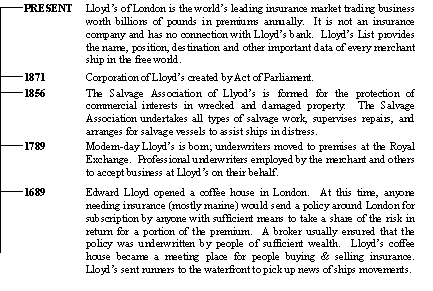
HISTORY OF LLOYD’S
Process of Insuring a Risk at Lloyd’s:
Lloyd’s Brokers: Act in interest of customer, paid commission by
Insurer. Brokers approach underwriters and describe the risks and
insurance requirements, and try to obtain the best possible price. The
broker must be able to find coverage of the whole risk by signing up syndicates
at the original agreed price. Brokers also advise clients on loss prevention.
Syndicates of Members of Lloyd’s: range in size, each syndicate represented by
an underwriter.
Unlimited Liability: Every individual member of Lloyd’s has proved wealth and
trades individually with unlimited liability.
Original Slip: Drawn up by the broker; contains details of the risk, insurable interests of the applicant. This is the basis of the contract and is initialed (or stamped) by Insurer. The Slip is evidence that the underwriter has accepted insurance and that he has agreed to sign a policy based on the terms & conditions of the Slip.
The Lead: This is the first underwriter to initial the slip, where more than 1 underwriter used; other underwriters initial the slip, ‘following the lead', until 100% of the risk is covered.
Lloyd’s Underwriters Association: Association of underwriters who meet for consultation on matters affecting the interest of underwriters of Lloyd’s.
Intelligence System of Lloyd’s: Various publications issued by Lloyd’s which
are indispensable to any marine underwriter:
1 Lloyd’s Register of Shipping: Annual publication with monthly updates;
contains details of virtually all vessels afloat (name, number, flag,
nationality, registered owners, managers, tonnage, type of
vessel/engine/auxiliary machinery).
2 Confidential Index: Published twice a year; contains record of ownership of
all vessels worldwide.
3 Confidential Ports Record: Lists information on all world ports of
significant size (name, country, Lloyd’s agent, approaches to ports, methods of
loading/unloading, craft risk, theft & pilferage risk, climate, customs
details, fire risk, port congestion, salvage & repair facilities).
4 Daily Shipping Index: Lists information on almost all vessels engaged in
ocean trade (name, flag, current voyage, date last sailing, date last report,
recent casualty, Lloyd’s casualty reports).
5 Casualty Report Service (Weekly Casualty Reports): Lloyd’s sends subscribers
casualty slips with information of all occurrences which are likely to affect
underwriting decisions.
6 Lloyd’s Survey Handbook: Contains information on treatment or survey of
damaged goods and the susceptibility of certain commodities to loss/damage.
Institute of London Underwriters (ILU):
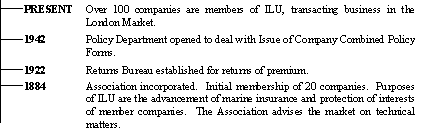
HISTORY OF ILU
International Union of Marine Insurance: Formed in 1874 to provide union between marine markets in Europe. Now over 30 countries are represented. Purposes of union are to advance marine insurance and protect those involved in the business.
Canadian Board of Marine Underwriters (American Institute of Marine Underwriters, Association of Marine Underwriters of British Columbia): Organization with voluntary membership; purposes are to promote marine insurance, protect interests of members, advise on technical matters.
American Hull Insurance Syndicate: Formed in 1920 to insure US ships, based in New York; mutual association that sets rates and accepts business up to $40 million per vessel, now throughout North America.
STUDY 2
Insurance Accounts:
1 Three-Year Method (Run-Off or Throw-Back Record) used in British marine
insurance market and in other areas by some companies. Each year’s marine
account remains open for 3 years. In the accounting record, a loss is
placed against the year of the premium which paid for it. This allows for
extensive and ongoing claims to be settled better.
2 One-Year Method (Earned Premiums, Incurred Losses): Used in other markets; a
percentage of the annual premium is reserved to cover outstanding losses.
Payment of Premiums: If insurance is effected through a broker, the broker is
responsible to the underwriters for the payment of premium. Insured can
sue broker if broker fails to pass on premium to Insurer. Lloyd’s
policies acknowledge receipt of premium, other companies’ policies do not, and
instead provide for cancellation in the event of non-payment of premium.
3 Broker’s Lien: For the protection of the broker (broker still liable to
underwriter even though he may be unable to collect premium from Insured),
broker may retain the policy until Insured pays the premium and other
outstanding accounts. As long as the Broker’s Lien is in place, no claims
may be collected on the policy and the policy cannot be used as security.
4 Deductions: Rate of brokerage (commission) for marine insurance in Canada is
10-15% ocean cargo, 15% commercial hull, 20% yachts.
Cover Note: After insurance placed, the broker (or underwriter if no broker used) sends his client a Cover Note to inform him of the insurance policy’s existence and its terms and conditions. The Cover Note does not take the place of a policy, but is of use to the Insured to sue the broker if he fails to carry out instructions.
Closing the Insurance:
1 Britain:
i Lloyd’s Policies: Prepared by broker; policy and Bureau slip lodged, checked,
and executed with Lloyd’s Policy Signing Office; policy impressed with seal of
Policy Office and collected by broker. Each syndicate’s line proportion
insured is shown; each subscription is a separate contract.
ii Companies’ Policies: Combined policy form used (since 1939) for all
subscribing companies; prepared by broker; policy passed to Institute of London
Underwriters for checking & signing.
2 Canada: Subscription Policies (Joint Policies) used for large risks so that
many companies can participate. Each underwriter accepts a proportion of
the risk and each signs the policy.
3 USA: Like Canada, but signing of Subscription Policy by American Hull
Insurance Syndicate.
Marine Adventure: For perils covered by marine contract--includes perils of the sea and is extended to include land risks incidental to the sea voyage and losses on inland waterways. The adventure must be lawful; there must be a ship, goods or other movables exposed to marine perils, or where the earning of freight/commission/profit endangered by marine perils. Marine Adventure also occurs where liability to a third party may be incurred by some person with interest or responsibility for the ship or goods.
4 Basic Principles of Marine Insurance:
1. Insurable Interest: The Insured must have financial interest in the
object of insurance. A person has insurable interest in property when he
will be financially prejudiced by its loss or damage and when he will
financially benefit from its continued existence. Every person has an
insurable interest who is interested in a marine adventure. A person also
has insurable interest in his potential responsibility (legal liability) to pay
damages to others for injuries he causes to them or damage he does to their
property. In order to recover for a loss, an Insured must have insurable
interest at the time of loss (not necessary to have insurable interest at the
time of effecting insurance). Without the rule of Insurable Interest, a
person could insure a vessel with the hope it would sink and collect the
insurance (called Wagering or Gaming). The Gambling Policies Act (1909)
provides for the criminal punishment of persons involved in illegal wagering in
marine insurance. Policy Proof of Interest (P.P.I.) or Honour policies
are used and in the event of a claim the policy is taken as sufficient proof of
insurable interest. Insurers must be careful to establish the probability
of insurable interest before issuing P.P.I. policies. Kinds of Insurable
Interest:
i Defeasible Interest: Interest ceases after beginning of Marine Adventure for
reasons other than marine perils. If risk ceases, no return of premium.
ii Contingent Interest: Interest acquired during the Marine Adventure due to a
contingency.
iii Partial Interest: Interest in the property insured does not have to be
100%--a person may insure up to the value of his share of the property.
iv Reinsurance: Interest is acquired in the property insured by the insurance
company and they may reinsure to protect their interest.
v Bottomry: Interest acquired by loan raised by captain of vessel on ship/cargo
when money urgently needed for prosecution of voyage, not repayable if venture
lost.
vi Respondentia: Interest acquired by advance secured on cargo repayable only
if cargo saved, even if ship lost.
vii Master’s and Seamen’s Wages: Individuals have interest in their own wages.
viii Advance Freight: Freight is the remuneration payable to a shipowner for
carriage of goods or for the hire of his ship or cargo space. Unless
freight is wholly or partly pre-paid, it remains at the risk of the shipowner,
who has insurable interest in it.
ix Insurance Premiums: The Insured has insurable interest for the premium he
has paid on the policy.
x Quantum of Interest: Insurable interest from insured property that is
mortgaged; only applies to property given as security for loan. Mortgagor
(borrower) retains full insurable interest as he must repay mortgagee (lender)
in event of loss; mortgagee has insurable interest to extent of the loan.
2. Indemnity: If a loss occurs, the Insured will be put back into the same
financial position as just prior to the loss. The Insured must not profit
from the loss. Most policies are on an actual cash value (ACV) basis (the
value of an equivalent piece of property of the same age and condition and
subject to the same wear and tear as the property that was lost or
destroyed). Exceptions:
i Valued Contracts: Insures property for an amount which is agreed to by the
Insurer and the Insured at the time the contract is made; in the event of a
total loss a definite amount will be paid. Valued policies are used for
insuring items that are difficult to valuate after a loss. Also,
Contracts of Compensation (Life Insurance).
ii Replacement Cost Contracts: The property damaged will be assessed on the
basis of the cost at the time of the loss, destruction or damage, of repairing
or replacing (whichever is less) with like kind and quality, without any
deduction for depreciation. Extra premium is charged for this type of
insurance.
3. Utmost Good Faith (Uberrima Fides): Required from both parties.
Insurer must deal with all claims fairly and expeditiously and be able to pay
for potential claims. Only Insured knows all the facts; he is required to
give full information of every material fact in respect to the risk; policy
voidable if Insured has not given full and correct information, by:
i Nondisclosure: Failure to inform the Insurer of a material fact.
Includes failure on the Insured’s part to find out all material facts of the
risk.
ii Misrepresentation: Incorrect statement about a material fact.
4. Subrogation: The right of an Insurer, after paying a loss, to assume the rights of the Insured to recover this loss from the responsible party.
Warranty: Promise by Insured as part of contract that a specified state of
affairs will continue to exist for duration of policy; breach of warranty makes
policy voidable from time of breach. Warranty may be express or implied;
2 implied warranties:
i Seaworthiness: Vessel must be seaworthy at commencement of voyage and at
start of each stage of the voyage if conducted in stages. Vessel must be
reasonably fit in all respects to encounter ordinary perils of the insured
voyage. After a loss, the onus is on the Insurer to prove vessel was
unseaworthy.
ii Legality: Voyage must be lawful and, so far as the Insured can control,
carried out in lawful manner.
Void Contract: Treated as if it never existed; cannot confer rights on
anyone and has no legal effect.
Voidable Contract: Can be affirmed or rejected at the option of the aggrieved
party.
Types of Policies:
1 Time Policy: Insures property for a period of time.
2 Voyage Policy: Insures property from 1 place to another, may include a date
limit.
3 Mixed Policy: Covers both a voyage and period of time of voyage and in port
after arrival.
4 Construction Policy (Building Risk): Insures vessel while in course of
construction, not for period of time.
5 Floating Policy: Cargo policy that insures a number of shipments to be
declared. In Canada & US, this policy is continuous and covers all
shipments to a limit of liability for any 1 loss.
STUDY 3
The S.G. (Ship: Goods) Policy Form: Standard marine policy form used by Lloyd’s; Voyage type of policy; S.G. Policy adopted by Lloyd’s in 1779, little change since. Although form is full or archaic terms, the policy has proven itself reliable in courts and Lloyd’s is reluctant to make changes. The policy is brought up to date by adding printed institute clauses to it. These clauses drawn up by Technical and Clauses Committee of the Institute of London Underwriters, printed by Witherby & Co., and used by whole marine insurance market.
Interpretation of Policy: Any ambiguity in the wording is construed ‘against
the offeror’ (Contra Proferentum). Use the following rules to determine
the meaning and importance of phrases in the policy:
1 Clauses printed in margin take precedence over clauses in body of text.
2 Printed/stamped clauses impressed on or attached to policy take precedence
over clauses printed in margin.
3 Typewritten wording takes precedence over all other wording except wording
added by hand.
4 Handwritten wording takes precedence over all other wording.
5 Overriding paramount clauses are printed in heavy type or italics or
indicated as such by the wording; these clauses take precedence over clauses
printed in ordinary type in body of text.
Policy Wording: Marine Insurance Act (M.I.A. 1st schedule) forms the basis
of all marine policies. Meanings of clauses & phrases:
1 Assignment Clause: Policy may be used by any person as a principle or agent
or assignee or any person who acquires at least partial interest.
2 Lost or Not Lost: Insurance accepted after the beginning of the adventure, or
even after a loss, is operative provided no breach of utmost good faith by
Insured.
3 Commencement & Termination of Risk:
|
COVERAGE TYPE |
COMMENCES |
TERMINATES |
|
HULL |
Voyage Basis, “at and from” specified place within reasonable time (unless delay known to Insurer or waived) |
When vessel “hath moored at anchor 24 hours in good safety” at port of destination |
|
GOODS |
When goods loaded on board vessel |
When goods safely landed |
|
FREIGHT (insured at or from specified place) |
Pro rata as goods shipped |
End of voyage |
|
CHARTERED FREIGHT |
When vessel is at specified place for start of voyage |
End of voyage |
4 Different Voyage: Vessel must sail from specified port of departure for the
specified port of destination, otherwise no coverage.
5 Change of Voyage: If the destination is voluntarily changed after beginning
the voyage, coverage ceases when the decision to make the change occurs.
6 Deviation: If the vessel leaves the stated or customary course of the voyage
with the intention of returning to that course and completing the voyage, no
coverage after vessel changes course.
7 Unreasonable Delay: No coverage as soon as delay becomes unreasonable.
8 Over Carriage: If goods are not discharged at destination and carried on
homeward voyage, no coverage after vessel leaves from destination with goods on
board.
9 Excuses for Deviation/Delay: Coverage will not cease in the following cases,
but immediately after the cause of deviation ceases, vessel must resume course:
10 Authorized: Change agreed to by Insurer in Deviation Clause.
11 Beyond Control: Change is beyond the control of the Insured and caused by
insured peril.
12 Comply: Delay needed to meet conditions of policy, e.g., to make vessel
seaworthy.
13 Deemed Necessary: Change needed to save voyage.
14 To save human life: Change needed to prevent death of some person.
15 Deviation or delay for humanitarian purposes: Change needed for some
humanitarian cause.
16 Barratry: Wrongful act of master/crew to detriment of owner.
Insured Perils:
17 Perils of the Seas: Fortuitous accidents and casualties of maritime
nature. Includes things that may happen at sea, not things which must
happen (like ordinary action of wind and waves), so wear & tear is
excluded. Egs., Stranding, foundering, collision or contact, heavy
weather damage.
18 Fire: Loss by fire is covered unless caused by inherent vice of insured
property. Damage from Lightning or Explosion not covered but fire caused
by lightning/explosion covered.
19 Men-of War and Enemies: Common War Perils.
20 Pirates and Rovers: Loss due to pirates including mutiny & riot.
21 Thieves: Loss/damage by assailing & violent thieves (not including crew
or passengers) who overcome guard of goods on voyage.
22 Jettison: Loss/damage due to throwing cargo/gear overboard at time of peril
for safety of adventure (not including cargo jettisoned because of inherent
vice).
23 Letters of Mart and Countermart: Permission granted by State to attack
foreign enemy’s merchant shipping.
24 Surprisals (Taking at Sea): Loss/damage from actual or attempted capture,
seizure, stoppage by enemy.
25 Arrests, Restraint, and Detainment: Loss/damage from political or executive
acts with or without force.
26 Barratry: Loss/damage caused by wrongful act willfully committed by master
or crew to detriment of owner or charterer.
27 All Other Perils: Subject to rule of Ejusdem Generis (of a like kind).
The Attestation: Final clause of policy followed by signature of Insurers.
Assignment of Interest: Transfer of interest in the property.
Assignment of Policy: Transfer of beneficial rights under policy. Marine
policy freely transferable before or after loss to any person (except enemies
or where policy prohibits assignment) with beneficial interest in the
property. This is necessary as goods may change hands many times during a
voyage. Assignee makes claim on policy in own name with the same rights
as original assignor.
STUDY 4
Proximate Cause: Immediate and effective cause of loss. Not
necessarily the last event before the loss. Coverage exists only if the
proximate cause is an insured peril. Scott v. Shepherd (1771), squib
case, definition of proximate cause. Also, Pawsey v. Scottish Union and
National (1907).
Remote Cause: A cause other than the proximate cause.
Immediate Cause: Last event before the loss.
Included and Excluded Losses:
1 Willful Misconduct: Loss/damage by willful misconduct of Insured never
recoverable, although cause may be an insured peril (e.g., Insured deliberately
set fire to own vessel). However, other parties will not be prejudiced by
this exclusion.
2 Negligence: Blyth v. Birmingham Water Works Co. (1856): “the omission to do
something which a reasonable man would do guided by those considerations which
ordinarily regulate the conduct of human affairs, would do, or the doing
something which a prudent and reasonable man would not do”. Loss/damage
due to negligence is covered as long as not willful act of Insured.
3 Delay: Loss/damage caused by delay not covered unless specifically included
by policy.
4 Wear & Tear: Loss/damage from wear & tear, ordinary leakage &
breakage, inherent vice, and vermin not covered unless specifically included by
policy.
5 Injury to Machinery: Loss/damage to machinery caused by insured peril
covered; caused by defect in machinery itself not covered.
6 Sympathetic Damage: Damaged cargo taints other cargo; covered only if
original damage from insured peril and no intervening cause.
7 Sentimental Damage: Fear of damage--not covered; cargo that has suffered a
casualty will sell at a lower price even though not damaged as buyers fear it
may have been damaged.
2 Types of Loss:
1. Total Loss: Limit of insurance applies; 2 Types:
i Actual Total Loss: Loss/damage to entire property (physical total loss); Can
occur 3 ways:
- All property is destroyed.
- Loss of Specie: All property so damaged as to cease to be a thing of the kind insured (cement damaged by water, becoming concrete).
- Insured irretrievable deprived of all property, even though not destroyed.
ii Constructive Total Loss: Cost to repair/replace exceeds policy limit (commercial total loss). Insured may claim for a partial loss or abandon the property and claim a total loss. Property must be reasonably abandoned because actual total loss appears inevitable or to prevent total loss requires an expenditure exceeding the saved value. It is a condition precedent to a claim that the Insured unconditionally abandons his interest to the Insurer. Insurer is entitled to take over the property if desired.
2. Partial Loss: Loss is less than total amount of insurance; loss/damage to
some of property.
i Particular Average: ‘Average’ means partial loss. ‘Free from Particular
Average’ (F.P.A.) means partial loss not covered. ‘With Average’ (W.A.)
means partial losses covered. ‘The Memorandum’ is a restrictive clause in
the policy that excludes coverage for Particular Average losses to certain
types of goods (usually perishables). ‘The Memorandum’ may exclude goods
under certain conditions or losses to certain goods unless a stated minimum
loss is reached (minimum percentage called the Franchise). Franchise
percentages are 5% for certain named goods (sugar, tobacco, hemp, flax, hides,
skins), 3% for ship, freight, and other goods. Once Franchise amount
reached, policy pays for total loss (not just amount in excess of Franchise).
ii Particular Charges: Expenses incurred by or on behalf of the Insured for the
safety or preservation of the property insured, excluding General Average and
salvage charges. Not included in Particular Average to reach Franchise
amount. Particular Charges can be incurred during the voyage or at
destination.
iii Sue and Labour Charges: Incurred short of destination. Insured incurs
charges while protecting property insured from loss/damage. Paid in full
in addition to amount of loss. Encourages Insured to take all possible
steps to protect property. Essential Features:
- Insured peril must have occurred; charges incurred to avert or minimize loss covered by policy.
- Charges must be incurred short of destination.
- Charges must be incurred for benefit of property insured.
- Charges must be reasonable.
- Charges must be incurred only by the Insured, his factors, servants or assigns (excludes salvage).
- Charges must be incurred only in connection with insured peril (charges incurred to reduce partial losses not recoverable on an F.P.A. policy).
- Extra Charges: Expenses of proving a claim, such as survey fees, auction or sale charges; paid by Insurer only if claim paid; not included in Particular Average to reach Franchise amount. Survey carried out on instructions of Insurer paid regardless of claim.
The Overdue Market:
1 Process of posting a ship ‘missing’ at Lloyd’s: If after reasonable time no
news received of overdue vessel, interested party applies to Lloyd’s for public
inquiry. Lloyd’s establishes when vessel last seen/heard. After
reasonable time, Lloyd’s posts ship missing--total loss claims then due for
collection.
2 Reinsurance can be arranged from Lloyd’s and other companies on vessels that
are overdue or have met with casualty. Rates depend on conditions &
situation of vessel, weather, and possibilities of salvage. Reinsurance
effected on conditions “to pay as original” or “total loss only”. Rare
now.
Transshipment: If a vessel is unable to complete a voyage because of an insured peril, goods are still covered for shipment aboard any other vessel.
The Waiver Clause: Neither party will be prejudiced by any steps taken to preserve the property, whether successful or otherwise.
STUDY 5
Measure of Indemnity: Amount of $ Insurer liable for following a loss;
depends on type of loss and type (valued or unvalued) of policy. If more
than one Insurer, each pays ratable proportion of measure of indemnity.
If Insured is underinsured, he pays proportion of loss himself.
1. Total Loss:
Claims for actual or constructive total loss treated the same:
i Valued: Sum fixed by policy.
ii Unvalued: Insurable value calculated as:
iii Ship: Value of ship at commencement of voyage, including outfit,
provisions, stores, advanced wages and other disbursements to make ship fit for
voyage, plus charges of insurance on the whole.
iv Freight: Value of gross amount of freight of Insured, plus charges of
insurance.
v Goods: Value of prime cost of property insured plus expenses of shipping and
insurance.
vi Other Property: Value is amount at risk to Insured when policy attaches,
plus charges of insurance.
Claims documents for Total Loss of Ship:
vii Insurance Policy.
viii Protest: Statement sworn by master giving details of casualty.
ix Certified List: List of all P.P.I. insurances from shipowner to ensure that
disbursements warranty not broken.
x Evidence: That any special warranty in policy complied with.
Claims Documents for Total Loss of Cargo:
xi Insurance Policy.
xii Protest.
xiii Invoices which confirm value, quantity & quality of cargo.
ixx Bills of Lading: Evidence of shipment of cargo and terms of carriage.
xx Letter of Subrogation: Insured authorizes Insurer to use Insured’s name in
proceedings.
2. Partial Loss of Ship: Measure of Indemnity is the reasonable cost of
repairs less customary deductions, not exceeding sum insured for any one
casualty. Successive losses do not reduce the sum insured.
i Deductions ‘New for Old’: Depreciation applied when new components utilized.
ii Partially Repaired & Unrepaired Damage: If ship not completely repaired,
Insured recovers cost of repairs plus allowance for depreciation due to
incomplete repair.
iii Temporary Repairs: If it is possible to only effect temporary repairs,
Insurer liable for temporary repair and subsequent permanent repair, up to
insured limit.
iv Overtime: Overtime wages for repairs covered where necessary for vessel to
keep scheduled voyage dates.
v Expenses of Removal: Cost of taking vessel to a port of repair or original
port if vessel can not be repaired at present location is covered.
vi Dry-Docking Expenses: Covered as part of repair.
Claims Documents for Particular Average on Ship:
vii Insurance Policy.
viii Reports of the shipowner’s, underwriters’, and classification society’s
surveyors.
ix Repair specifications.
x Details of tenders (if taken).
xi Receipts for all repairs & disbursements.
xii Average adjustment details.
3. Partial Loss of Freight: From failure to deliver part of cargo from
insured peril where voyage terminated short of destination or part of cargo
destroyed short of destination. Measure of indemnity is amount of freight
lost up to total freight insured with 100% co-insurance.
Claims Documents for Particular Average on Freight:
i Insurance Policy.
ii Protest.
iii Manifest & Freight Accounts.
4. Partial Loss of Cargo:
1 Apportionment of Valuation: Different species of goods may be insured under
one policy; apportionment of insured value based on invoice values of various
goods.
2 Apportionable Part: If different goods are insured under one policy, Insured
can claim total loss of an apportionable part (loss of a whole species of
goods) of cargo, even if policy warranted free from particular average.
3 Damage Claims: Partial loss of cargo occurs where goods delivered at
destination, damaged by deterioration or diminution, or with marks
obliterated. The difference between the estimated arrived sound value and
the actual arrived damaged value is the amount of the loss to the cargo
owner. Settlement is based on the percentage of depreciation of the
insured value.
4 Gross Values: Wholesale price on the day after freight, landing charges &
duty paid. Gross Proceeds: Price of goods obtained at sale, all charges
of sale paid by seller.
5 Net Values: Destination charges same for sound or damaged cargo; Net Values
Clause (no longer in use) permits coverage for this expense in event of partial
loss.
6 Bonded Values: Where goods customarily sold in bond (like alcohol), bonded
price considered gross value.
Average Clauses, Cargo:
7 The Memorandum.
8 Series: As shipments can be very large they are broken down into ‘series’ for
franchise purposes so that amount of self-insurance reduced.
9 Running Landing Numbers: Commodities are grouped in series in the order that
they are landed.
10 Average Each Package: Extension of series practice; commodities insured on
basis of an average payable on each package separately or on the whole.
11 Average Irrespective of Percentage: Memorandum percentage does not apply;
all particular average claims paid in full.
12 Salvage Loss: If cargo badly damaged short of destination, Lloyd’s agent at
intermediate port may agree to sell at best price. Settlement based on
difference between insured value and net proceeds of sale.
13 Average Each Package: Extension of the series concept; certain commodities
insured on term of average payable on each package separately or on the whole.
14 Average Irrespective of Percentage: All particular average claims paid in
full--no Franchise.
15 Salvage Loss: If cargo damaged short of destination, Lloyd’s agent at
intermediate port may agree to sell goods at best price; settlement based on
difference between insured value & net proceeds of sale.
Claims Documents for Particular Average on Cargo:
16 Insurance Policy.
17 Invoice showing cost and charges.
18 Bill of Lading.
19 Survey Report of approved surveyor showing cause of loss/damage, values,
etc.
20 Account Sales and Landing Account may be required.
21 Letter acknowledging or repudiating liability from carrier for liability
cases.
5. Sue and Labour Charges: Measure of Indemnity of such charges if properly
incurred is full payment.
General Average: System for settling marine losses voluntarily incurred for
safety of common adventure; equity principle; developed separately from marine
insurance. From Rhodian Law (900 B.C.), still exists today “Let that
which has been jettisoned on behalf of all be restored by the contribution of
all. A collection of the contribution for jettison shall be made when the
ship is saved.” Essential features of a General Average act:
1 In a time of peril the common adventure must be imperiled; danger must be
real and imminent.
2 Act must be voluntary and intentional, not inevitable (accidental loss/damage
excluded).
3 Act must be reasonably made; prudent sacrifice or fair and reasonable
expense.
4 Loss must be extraordinary in nature.
5 Act must be for preservation of whole adventure.
6 Adventure must be saved.
7 Loss must be directly consequential on the general average act.
Losses not allowed by General Average:
8 Losses through delay.
9 Losses not directly consequential on general average act (e.g., damage to
cargo while stored ashore during repairs at a port of refuge.)
10 Where no loss sustained by general average act (e.g., water poured on
damaged goods as goods already damaged by fire).
11 Loss of cargo through wrongful act of shippers.
12 Expenses incurred by shipowner in performing his obligations under contract
of affreightment.
13 Losses attributable to the fault of the shipowner, unless protected by
contract of affreightment.
STUDY 6
Application of General Average to Insurance: Insurer liable for general average loss for insured peril:
Measure of Indemnity for General Average Contributions: Full amount of contribution up to insured value.
Direct Liability for Sacrifices: Insured can recover in full from Insurer without enforcing his right of contribution from other parties liable to contribute. Measure of Indemnity is the insured value.
Salvage Agreement: Services for salvage must be rendered independently of contract; most salvors subscribe to
Lloyd’s Standard Form of Salvage Agreement. If property not saved, salvor receives nothing (no cure, no pay). Measure of Indemnity same as General Average Contributions. If services successful, salvor receives stated sum or amount determined by arbitrator. Salvor cannot claim salvage for peril caused by his own negligence or wrongful acts.
Arbitration: Factors taken into consideration by arbitrator or Admiralty
Court in awarding salvage:
1 Peril to which salved property exposed.
2 Nature of services.
3 Degree of danger, merit of services.
4 State of weather.
5 Value of ship, cargo, etc. exposed to peril.
6 Value of property saved.
7 Measure of success of salvage operations.
Double Insurance: 2+ policies issued on behalf of 1 insurable interest, and
total sums insured exceeds indemnity (over-insurance). Usually, both
Insurers pay for 50% of claim. Can occur in 2 ways:
1 Purposely: Rare; sometimes a bank refuses to accept policy unless provided by
particular Insurers--another policy is required. No return of unearned
premium.
2 Inadvertently: Sometimes an agent will purchase coverage and principle
already has coverage. Both Insurers return 50% of unearned premium in
event of loss.
Subrogation: After a claim has been settled and paid, the Insurer is entitled to place himself in the position of the Insured, to the extent of acquiring the Insured’s rights & remedies in respect of the loss. This prevents Insured from collecting for his loss twice, and reduces the total cost of the claim. The Insurer will sue a responsible party in the Insured’s name for the loss/damage up to the amount of the settlement. The Insured must not relinquish any rights that he may have against other parties.
Returns of Premium: 2 Kinds:
1 For Failure of Consideration: Liability which Insurer agreed to assume has
not attached or commenced, and he is not entitled to keep premium. The
period covered by the policy is indivisible once risk has attached, so no return
of premium if policy void after start of voyage.
2 By Agreement in the Policy: Policy contains agreements to return percentages
of premium in certain circumstances. E.g., To return 4% if packed in
tin-lined cases.
STUDY 7
INSTITUTE TIME CLAUSES (I.T.C.)--HULLS (1.10.70): Used for ocean going
vessels; other vessels covered by clauses which closely parallel these
clauses. Provides standard cover for insurance of hulls on a time basis
(not voyage basis). Consists of 24+ clauses, each with the same force
& effect except the Running Down Clause:
|
# |
NAME |
DESCRIPTION |
|
1 |
Running Down Clause |
Provides limited coverage for liability for damage and
legal costs from collision (actual contact only) with another ship, with a
maximum indemnity of 3/4 of the insured value. Right of recovery
restricted to liability for: |
|
2 |
Sistership Clause |
Protects shipowner in event of collision between ships in same ownership, as person cannot sue himself. Arbitrator is appointed to determine liability and Insurer bound to decision. |
|
3 |
Tow and Assist Clause (Adventure Clause, Permissions Clause) |
Vessel covered during whole policy period, regardless of situation (except breach of warranty, overriding policy conditions). Vessel must not undertake towage or salvage services under contact, nor towed except where customary or in need of assistance. Abnormal loading/discharging at sea not covered unless previously agreed. |
|
4 |
Continuation Clause |
Extension of policy (after expiry of time policy) provided on pro rata monthly basis with previous notice to Insurer. Useful for vessel in distress or damaged--policy continued until extent of loss determined. |
|
5 |
Breach of Warranty Clause |
Insured must exactly comply with warranty--or Insurer can avoid contract from time of breach. Breaches of Institute Warranties are held covered subject to additional premium. |
|
6 |
Change of Ownership Clause |
Coverage on vessel after ownership/management change only if prompt notice received and agreed by Insurer; pro rata return of premium if cancelled. |
|
7 |
Inchmaree Clause (Negligence Clause, Additional Perils Clause, Latent defects Clause) |
Protects shipowner against loss/damage directly caused by
negligence of master or crew (from Inchmaree case in 1887, Thames &
Mersey Marine Insurance Co. v. Hamilton, Fraser & Co.) Cost to
replace component with latent damage not covered--resultant damaged
covered. Extended to cover other forms of damage by listing additional
perils: |
|
8 |
Foreign General Average Clause |
Provides for acceptable rules to determine amount of a General Average loss. Insurer acknowledges adjustments drawn up at place where adventure ends or according to York/Antwerp rules (except rules XX & XXI--interest on expenditure) where provided in contract of affreightment. |
|
9 |
Sue and Labour Clause |
Measure of indemnity for sue and labour charges is full payment whether interest fully insured or not (pro rata payment due to under-insurance applies only to amount in excess of value of proceeds) and even in addition to total loss. |
|
10 |
New for Old Clause |
Provides for claims paid without deductions for depreciation due to wear and tear; old components are replaced with new components (Replacement Cost basis). |
|
11 |
Deductible |
Applicable to Negligence For losses under Inchmaree Clause (#7) Part (a), additional deductible of 10%, not including total/constructive total loss |
|
12 |
Average Clause (Deductible Clause) |
A deductible (amount of $ deducted from the claim) applicable in all cases, even if vessel strands. A space is left blank on the form for the deductible amount to be inserted. The deductible applies to the aggregate of claims arising from each accident or occurrence. The deductible applies to all claims (including General Average, Running Down Clause, Sue & Labour Clause) except total loss claims. Clause specifies apportionment of deductible for overlapping policies, etc. |
|
13 |
Suez Canal Clause |
Groundings at specified places (Suez, Panama, Manchester Ship Canals; Plate Danube, Demerara Canals; Yenikale Bar) not considered strandings. |
|
14 |
Scraping and Painting Clause |
Costs for scraping and painting the underwater part of the vessel due to fouling are not covered. |
|
15 |
Wages and Maintenance of Crew |
Wages & maintenance of master, officers, crew, other members, not covered in particular average claims--except while underway on removal of vessel to port of refuge. |
|
16 |
Unrepaired Damage |
Insurer is required to pay for reasonable depreciation due to unrepaired damage, but not until expiry of policy (or expiry of continuation of policy). |
|
17 |
Valuation Clause, (Constructive Total Loss Provisions) |
Provides rules to ascertain value of ship to determine if a vessel is a constructive total loss. Insured value is considered to be the repaired value; salvage values not considered. |
|
18 |
Freight Abandonment Clause |
For constructive total loss of ship, Insurer not entitled to earned freight, whether abandoned or not. |
|
19 |
Tender Clause |
Notice of any accident must be given to Insurer. Insurer has the right to decide the port which the vessel shall proceed for repairs and the right to veto any suggested repair firm. Insurer has the right to require the Insured to call for tenders for the repairs. Allowance of 30% per year for time lost waiting for acceptance of tender. 15% deductible penalty for failure to comply with this clause. |
|
20 |
Disbursements Warranty |
Restricts the amount of ancillary insurances which a
shipowner may effect on restrictive conditions as additional cover to the
amount insured on hull & machinery on the policy. Ensures adequate
sum insured and prevents insured from obtaining insurance at lower cost by
utilizing large ancillary insurances. Clause prescribes types of
acceptable ancillary insurances: |
|
21 |
Returns Clause |
Insurer agrees to return percentage of premium for 30+ consecutive days where vessel laid up in port (covers port risks only during this time). Based on balance of net premium paid in excess of prescribed retention. Returns shared between Insurers for overlapping policies. most returns of premium are by agreement “and arrival”--no return if total loss before policy expiry. |
|
22 |
Assignment Clause |
Marine policy freely assignable unless it contains terms expressly prohibiting assignment. |
|
23 |
Free of Capture and Seizure (F.C. & S.) Clause |
Common war perils excluded. |
|
24 |
Additional War Perils |
Additional war perils and malicious and political acts excluded. |
|
25 |
Nuclear Materials |
Loss/damages from nuclear weapon or by radioactive material excluded. |
The Liner Negligence and Additional Perils Clause: Added to I.T.C. clauses to give broader cover to liners. Covers replacement of component with latent defect (only if damage results) as well as resultant damage. Covers burst boilers and broken shafts regardless of cause.
Shipowners’ liabilities: Insurable liabilities to cargo owners or third
parties arise from:
1 Torts: Wrong or injury not arising out of contract, e.g., collisions.
2 Statutory Powers: Local statutory regulations may make shipowner liable for
damage to harbours, docks, etc., cost of removal of wreck, pollution clean-up.
3 Breach of Contract: Liability may arise from contract of affreightment (e.g.,
unseaworthiness, unreasonable deviation), et al.
Protection and Indemnity Clubs: Associations which provide protection for
liabilities not covered (loss of life, BI) by the marine insurance
policy. Covers rest of claim not covered by the marine policy in some
cases (e.g., 25% of liability to 3rd party not covered by marine policy,
covered by P & I club). Shipowner enters vessels at start of
financial year into P & I club based on tonnage; claims are paid by the pool.
Heavy claims during the year may result in additional levy (call). 4
classes of liabilities covered:
1 Protection: Protects shipowner for claims for loss of life/BI, damage to
fixed objects, penalty from Running Down clause, life salvage.
2 Indemnity: Protects shipowner for indemnity payments to cargo owners for
damage caused by negligence of crew.
3 War Risks
4 Freight War Risks.
Limitation of Liability: Shipowner or other interested person can ask Court
to grant an order limiting his liability for loss/damage without his actual
fault or privity to any property by reason of improper navigation or management
of ship. Suits may be filed in personam (against the shipowner) or in rem
(against the ship). Applicable limits (plus interests and costs):
1 Loss of life/BI alone or together with PD: 3,100 (first 2,100 set aside for
Life/BI) gold francs per ton net vessel weight.
2 Property damage only: 1,000 gold francs per ton net vessel weight.
Collision Liabilities: Damage by collision includes any damage done by ship in
contact with (and by the ship’s wake, or by crowding a ship in a channel, etc.)
another ship, or other objects. Damage includes physical damage to other
ship/cargo/freight/employment, loss of life/BI, damage to all fixed/movable
objects, and infringement of rights on land or water. Causes of
Collision:
3 Inevitable Accident: Collision could not have been avoided by ordinary care
& skill--no liability. E.g., typhoon.
4 Inscrutable Fault: Collision caused by a fault which cannot be proved or attributed
to either ship--no liability.
5 Negligent Navigation: Breach of Regulations for Prevention of Collisions at
Sea (or other duty of reasonable care in the navigation or management of the
ship) which directly leads to damage--shipowner liable for damages caused.
6 Contributory Negligent Navigation: Where each vessel is partially to blame,
damages split between vessels to the degree that they were at fault (Marine
Conventions Act 1911 for most areas) or, rarely, equally divided between the
vessels (Admiralty Rule, Merchant Shipping Act 1894). If 2 ships are
responsible for damages to 3rd ship, 3rd shipowner can recover total amount of
damages from either vessel (Joint & Several Liability). Cross
Liability: In collision with 2 vessels where contributory negligence
exists, the Insurer of each vessel pays percentage of loss to other--but in
reality, only the balance passes. Both Insureds’ premium and loss records
are adjusted to reflect the extent to which he was to blame.
Demurrage: Loss of employment of the ship; this is not covered if caused by delay not from insured peril.
Institute Freight Collision Clause: Insurer liable for freight at risk for liability due to collision with another ship.
Collision in Wartime: Insurer still liable for collision due to negligent navigation under Running Down Clause (separate from policy, which excludes war risks) even if attributable to war perils.
Tug and Tow: For collisions that occur while insured vessel under tow, degree of fault of all parties must be established; damages may be covered under policy or Running Down Clause, depending on circumstances; in Canada, most liability usually imposed on tow vessel by Standard Towing Conditions.
THE CANADIAN BOARD OF MARINE UNDERWRITERS GREAT LAKES HULL CLAUSES (1.9.71):
Attach to the plain form of marine policy for vessels trading on the Great
Lakes. Features:
a) Inserted are Name Insured, Loss Payees, Duration of Risk.
b) Inserted are Agreed Insured Value, Eastern Navigation Limit.
c) Deductible: Amount inserted, applies same as I.T.C.-Hulls. Deductible
of $50,000 or 10% of insured value, whichever lesser for damages caused by ice.
d) Premium: Agreed premium inserted; payable by 60 days of attachment or
November 1st, whichever less.
e) Underwriters Surveyor: Name of surveyors who will represent Insurer in event
of claim.
f) Returns of Premium: Allowed for:
- Termination of insurance under change of ownership clause: Pro rata daily net.
- Mutually agreed cancellation: Pro rata monthly net for each uncommenced month.
- Laid-up: Pro rata daily net of navigating rate for each period of 15 consecutive days March 31 to December 15.
g) Trading Warranty & Season of Navigation: Vessel
warranted confined to waters of the Great Lakes with eastern navigation limit,
not engaged in navigation March 31 to December 15 (except with approval).
h) Winter Moorings: Approved place for winter lay-up.
i) Adventure: Like I.T.C.-Hulls; covered for breach of towage/salvage with
immediate notice to Insurer.
j) Perils: Insured perils listed--same as plain form of policy.
k) Additional Perils (Inchmaree Clause): Additional perils listed, covered for
resultant damage only: Accidents in loading/discharging/handling cargo;
accidents in loading boat onto/off of drydocks; explosions on shipboard or
elsewhere; mechanical breakdown; nuclear perils; contact with aircraft;
negligence of charterers/repairers other than named Insured; negligence of
masters, officers, crew, pilots.
l) Claims (General Provisions): Prompt notification of claims required; Insurer
may decide port of refuge for vessel and appoint surveyor. General
points:
- Particular Average does not include wages & maintenance of crew, except to remove vessel to port of repair.
- All claims payable without deductions new for old (no depreciation).
- Claims adjusting using Rules of Practice for the Great Lakes of the Association of Average Adjusters of Canada.
- Cost of sighting bottom after stranding (reasonably incurred for that purpose) covered.
- Increase in cost of repairs not covered if 15+ months after casualty.
- Cost of scraping/painting vessel bottom not covered.
- 15% total claim penalty for failure to comply with claims provisions.
- Loss/damage to equipment/apparatus on board covered up to amount paid for actual/contractual damage if owned by Insured.
- Fees of Insured, his superintendent or other servant not covered (except reasonable fee where own supervisor engineer necessary to supervise repairs).
m) General Average & Salvage: Provisions:
- General Average & Salvage payable as provided by contract of affreightment.
- Sister-ship provision for salvage/towage services for vessels of same ownership.
- General Average & Salvage reduced proportionately for under-insurance.
n) Total Loss: Provisions:
- For constructive total loss, cost of recovery & repair has to be demonstrated to exceed insured value.
- Insured value considered repaired value for constructive total loss; salvage not considered.
- For total loss of ship, Insurer waives right to freight.
- Insurer not liable for unrepaired damage in addition to total loss during same policy period.
o) Sue and Labour: Charges covered without deductible but
are reduced by under-insurance.
p) Collision Cause: Like Running Down Clause (I.T.C.-Hulls); not limited to 3/4
coverage. Each vessel responsible for proportion of liability to which it
was at fault (Cross-Liability). Sister-ship provisions same as
I.T.C.-Hulls. This clause does not cover removal/disposal of wrecks;
injury to real/personal property; environmental/pollution liability; loss of
life/BI.
q) Change of Ownership: Like I.T.C.-Hulls.
r) Additional Insurances--Disbursements Warranty: Like I.T.C.-Hulls.
s) War, Strikes and Related Exclusions: Excludes loss/damage to property
directly caused by:
- Capture, seizure, arrests, restraints, detainments.
- Taking vessel by requisition or otherwise.
- Mines, bombs, torpedoes not carried on board as cargo.
- Weapon of war with atomic/nuclear/radioactive material.
- Civil war, revolution, rebellion, insurrection or civil strife.
- Strikes, lockouts, political or labour disturbances, civil commotions, riots, martial law, military power, malicious acts or vandalism.
- Hostilities and warlike operations.
THE AMERICAN INSTITUTE GREAT LAKES HULL CLAUSES (1.7.71):
Attach to the plain form of marine policy for vessels trading on the Great
Lakes. Like Canadian Board Clauses with the following differences:
1) Deductible applies to aggregate of all claims (including General Average,
Salvage, Sue and Labour), not each claim separately.
2) No equivalent to the Inchmaree Clause; no additional deductible for
specified perils.
3) Separate rates for vessel while navigating and while in port.
4) No provision for automatic termination of insurance if premium not paid.
5) For particular average, wages & maintenance of crew covered only for
removal and to test average repairs.
6) Underwriters’ surveyors not named in policy.
7) Season of navigation open to negotiation; not specified.
8) Specified geographical limits of navigation.
9) No provision to use Rules of Practice for the Great Lakes of the Association
of Average Adjusters of Canada.
10) General Average adjusted according to contract of affreightment or
York-Antwerp Rules (1950)
11) No penalty of 15% for failure to comply with claims provisions.
12) No wording regarding the fees of the owner’s superintendent.
STUDY 8
The Free of Capture and Seizure Clause (F.C. & S.): Exclusion clause,
added to policy in 1898 to delete war perils. Listed war perils (and
other war perils of like kind) are excluded. Prior to 1918, the deletion
of the F.C. & S. Clause was used to reinstate war perils; now a separate
set of War Clauses are added. Deletion of F.C. & S. Clause merely
reinstates coverage of war perils stated in plain form, unless other perils
specifically stated. F.C. & S. Clause contains:
1 Capture: Seizure by an enemy in wartime or by rebels or insurgents at any
time.
2 Seizure: Broader term; includes capture, and seizure by neutral or
belligerent or revenue officer of foreign power. Seizure may be unlawful,
but covered if adventure is lawful. Mere capture or seizure does not give
rise to a claim, as property may be returned--there must be a condemnation
(destruction or loss of use).
3 Arrests, Restraints and Detainments: Political or executive act, but not
including loss by riot or ordinary judicial process.
4 Consequences of Hostilities or Warlike Operations, whether there be a
declaration of war or not: Vessel not covered if engaged in warlike operations
and loss is the direct result of these actions (carrying war stores or
personnel directly engaged in fighting the enemy).
5 Piracy: Added in 1937 to list of excluded perils.
INSTITUTE WAR CLAUSES--CARGO: Policies (time or voyage) contain the F.C.
& S. Clause to exclude war risks; separate policies are effected for
insurance on hulls to cover war risks:
1 The (War Risks) Waterborne Agreement (1937): Insurers agreed that property
(with the exception of marine policies) should not be covered for war
risks. Protection against war risks needed for overseas trade. The
Waterborne Agreement gave protection for cargo before shipment and for 15 days
after discharge for transshipment. Currently, the protection afforded by
this agreement has been completely reversed. The current Institute War
Clauses cover cargo only while in the overseas vessel, except for damage caused
by derelict mines or torpedoes.
2 The Frustration Clause (1921): Frustration of a voyage is the prevention of
arrival at an enemy destination by your own nationals without loss or damage to
the insured interest. The Frustration Clause inserted on all voyage
policies covering war risks--excludes loss due solely to frustration.
3 General Average Clause.
4 Deviation Clause.
5 Reasonable Dispatch Clause.
INSTITUTE STRIKES CLAUSES--CARGO: Plain form (Clause 13) excludes direct
& indirect damages due to all forms of civil strife (strikes, lockouts,
riots, etc.) Clause 13 may be deleted and the Institute Strike Clauses
added to provide protection for strikes risks. Includes malicious acts of
strikers. Damage caused by delay not covered. Indirect loss still
excluded if caused by:
1 Delay, inherent vice, nature of insured property.
2 Absence, shortage, withholding of labour.
INSTITUTE WAR AND STRIKES CLAUSES--HULLS: The hull war and strikes clauses
have been combined in 1 set; coverage like that for cargo war and strikes
clauses. Also excluded:
1 Loss, damage, or capture from requisition or preemption not covered.
2 Infringement of quarantine or customs regulations.
INCREASED VALUE: Where policy effected on “increased value of cargo” (after voyage commenced, value of cargo increased), these policies are excess to the primary policy.
INSTITUTE DANGEROUS DRUGS CLAUSE: Clause added to all cargo policies. Unless authorized by government, no drugs falling under authority of International Conventions of Dangerous Drugs (including illegal drugs) are covered.
STUDY 9
INSTITUTE CARGO CLAUSES: 3 sets in general use, each with 14 sub-clauses,
each vary (only) with different way of handling Particular Average.
|
# |
NAME |
DESCRIPTION |
|
1 |
Transit Clause (1963), (Incorporating Warehouse to Warehouse Clause) |
Cover attaches from time goods leave warehouse or place of storage named in policy for commencement of transit. Cover continues for ordinary course of transit and terminates on delivery to destination warehouse, to other warehouse for storage or distribution, or 60 days after discharge, whichever first. |
|
2 |
Termination of Adventure Clause |
Provides special cases for termination of affreightment and termination of adventure before delivery. For coverage to continue, conditions must be beyond control of Insured and prompt notice to Insurer. |
|
3 |
Craft Clause |
Goods covered in craft while transported to and from vessel. Each craft is separate insurance. |
|
4 |
Change of Voyage Clause |
Insured held covered subject to extra premium for change in voyage or error/omission in description of property/vessel/voyage. |
|
5 |
Average Clause |
Particular Average clauses modify the Memorandum and apply
to perils remaining in plain form after F.C. & S. clause has
operated. Particular Average clauses:
3. All Risks (A.R.): Covers cargo on an all-risks basis (all perils covered unless specifically excluded); loss must be fortuitous. Excludes wear and tear, inherent vice, poor packing. |
|
6 |
Constructive Total Loss Clause |
Constructive total loss payable only where cargo reasonably abandoned as actual total loss appears inevitable or cost of recovery exceeds value. |
|
7 |
General Average Clause |
Insurer pays General Average in accordance with York-Antwerp Rules. |
|
8 |
Seaworthiness Admitted |
As Insured may not have control over vessel, the seaworthiness of the vessel is agreed by the Insurer. Insurer retains rights of subrogation against shipowner for unseawothiness. |
|
9 |
Bailee Clause |
Insured must take all steps to prevent/minimize a loss and not prejudice the subrogation rights of the Insurer. |
|
10 |
Not to Inure Clause |
Carriers/bailees may not avoid liability by existence of insurance. |
|
11 |
Both-to-Blame Collision Clause |
Insurer pays for amount cargo owner liable for in collision with immediate notice so Insurer can defend. Normally, liability split 50/50 between both vessels if both partly at fault. |
|
12 |
Free of Capture and Seizure (F.C. & S.) Clause |
Excludes loss/damage from war, capture, seizure, and piracy. If deleted, the Institute War Clauses attach. |
|
13 |
Free of Strikes, Riots and Civil Commotions (F.S.R. & C.C.) Clause |
Excludes loss/damage from strikes, riots, and similar perils. If deleted, the Institute Strikes, Riots and Civil Commotions Clauses attach. |
|
14 |
Reasonable Dispatch Clause |
Insured must always act with reasonable dispatch (prompt notice) in all circumstances within his control. |
INSTITUTE TIME CLAUSES--FREIGHT:
|
# |
NAME |
DESCRIPTION |
|
1 |
Tow and Assist Clause |
Same as I.T.C.-Hulls. |
|
2 |
Craft Clause |
Loss of freight while goods in craft transported to or from vessel covered. |
|
3 |
Inchmaree Clause |
Same as I.T.C.-Hulls. |
|
4 |
Average Clause |
Memorandum franchise of 3% applies to Particular Average of freight unless damage from vessel sinking, fire, or collision. |
|
5 |
Foreign General Average Clause |
Same as I.T.C.-Hulls. |
|
6 |
Total Loss Clause (Including Valuation Clause) |
For total loss of vessel, total insured amount paid--regardless of state of voyage. |
|
7 |
Gross Freight Clause |
Measure of indemnity for Particular Average shall not exceed gross freight actually lost. |
|
8 |
Time Penalty Clause |
Effectively eliminates liability for loss of freight due to delay. |
|
9 |
Sale of Vessel Clause |
Same as I.T.C.-Hulls. |
|
10 |
Sister-Ship Clause |
Same as I.T.C.-Hulls. |
|
11 |
Breach of Warranty Clause |
Same as I.T.C.-Hulls. |
|
12 |
Continuation Clause |
Same as I.T.C.-Hulls. |
|
13 |
Returns Clause |
Same as I.T.C.-Hulls. |
|
14 |
Assignment Clause |
Same as I.T.C.-Hulls. |
|
15 |
Free of Capture & Seizure Clause |
Same as I.T.C.-Hulls. |
|
16 |
Arrests, Restraints, Detainments Exclusions |
Same as I.T.C.-Hulls. |
|
17 |
War and Malicious Damage Exclusions |
Same as I.T.C.-Hulls. |
|
18 |
Nuclear Exclusions |
Same as I.T.C.-Hulls. |
OTHER CLAUSES:
1 Institute Time Clauses, Hulls--Excess.....Particular Average: Like
I.T.C.-Hulls, but provides excess payable on the whole instead of franchise (no
separate valuations). Amount of excess inserted; excess applies only to
Particular Average and to voyage, not each accident.
2 Institute Time Clauses, Hulls--Free of Particular Average Absolutely: Like
I.T.C.-Hulls, but no coverage for Particular Average or General Average damage
to hull. Still covered are partial losses from extinguishing fire,
contact during salvage, General Average of machinery, and General Average
contributions.
3 Institute Time Clauses, Hulls--Free of Damage Absolutely: Like
I.T.C.-Hulls--Free of Particular Average Absolutely, but very restricted
coverage. Partial losses not covered. General Average contributions
covered.
4 Institute Yacht Clauses: Like I.T.C.-Hulls, but provides comprehensive cover
for pleasure craft. Particular Average covered regardless of
percentage. All Risks coverage (fortuitous losses only) with many stated
exclusions.
5 North American Yacht Clauses: Like I.T.C.-Hulls, variable wordings, for
pleasure craft. All Risks coverage (fortuitous losses only) with many
stated exclusions. Navigating limits more restricted than with commercial
vessels. In Northern climates, vessels warranted laid-up for part of the
year and freezing damage excluded. Exclusions regarding speed and racing
may exist. Vessel may be warranted for private pleasure, with extra
premium charged for commercial use (chartering, etc.) Protection and
Indemnity added for extra premium. There may be restrictions regarding
water-skiers. Condition surveys are usually required for effecting
insurance.
6 Institute Clauses for Builders’ Risks: Provide coverage to builder for vessel
under construction from first laying of keel until delivery to owner. All
Risks coverage, no franchise, full coverage Running Down clause, Protection and
Indemnity covered. Materials in workshop not covered.
7 Institute Port Risk Clause: Provides coverage to vessel laid-up out of
commission; All-Risks comprehensive coverage like Builders’ Risk.
Protection and Indemnity covered.
8 Excess Liabilities Clause (Hulls): Extra insurance purchased at nominal
premium to cover excess liabilities (excess of General Average or Salvage
charges which are based on ACV, excess of collision liability limited by weight
of vessel, etc.)
9 Dual Valuation Clause: Limits the liability for total loss of ship to sum
near market value of vessel, with higher amount for Particular Average--maintaining
the franchise at a reasonable level.
STUDY 10
FLOATING POLICIES: For long term coverage of vessels; no need to separately
insure each voyage. Types of Floating Policies:
1 Ocean Cargo Open Policy: North American policy continuous until cancelled
(many years); covers all shipments imported/exported. Settlement based on
Valuation Clause--cargo is valued, premium included, at invoice price including
all charges plus prepaid, advance, or guaranteed freight, plus an agreed
percentage (usually 10-15%). Percentage increase allows profit for total
loss, but prevents under valuation. There are limits of liability for any
1 shipment and in any 1 location. War, Strikes, and Riots cover is added
by endorsement.
2 London Equivalent Policies: Like above, but continuous until cancelled or for
specified period or until sum insured exhausted by accumulation of values of
shipments, then must be renewed. Open Cover Policy runs 12 months, then
must be renewed. Each shipment covered must be promptly declared so that
Marine & War premiums are assessed.
3 Hull Open or Declaration Policy: Rare, like above, but for hull.
Reinsurance: Insurer cedes part or whole of risk insured to reinsurer.
Purposes:
1 Relieve Insurer of excessive liability in any 1 risk or location (spreads the
risk, although in most cases marine policies are on a subscription basis and
each underwriter only accepts percentage of risk desired).
2 To secure foreign business through reciprocal reinsurance (rare in marine
insurance).
3 Insurer may reinsure for Total Loss only or Free of Particular Average only,
so that he is able to accept more business.
4 Change in risk due to seasonal or political conditions.
Reinsurance placed through broker, on original conditions/rates or restricted conditions/rates. Reinsurance is a separate contract; original Insured has no rights or interest with respect to reinsurance.
Ex Gratia Payments: If Insurer makes ex gratia (Insurer has no legal liability, but settlement to maintain good relations) payments to Insured, reinsurer is under no obligation to reimburse him.
2 Methods of Reinsurance:
1 Proportional: Percentage of risk transferred to reinsurer and reinsurer
receives same percentage of original premium and is responsible for same
percentage of each loss.
2 Non-Proportional: Percentage of risk transferred to reinsurer; Insurer pays
all of a loss up to an agreed amount called the priority; reinsurer pays all or
part of the loss which exceeds the priority up to an agreed limit.
Reinsurance premium is negotiated.
2 Types of Reinsurance:
1 Treaty: Agreement between Insurer & reinsurer which provides automatic
reinsurance for a whole class of insurance without the Insurer having to submit
each risk to the reinsurer. Less costly, less time-consuming, less
flexible.
2 Facultative: Reinsurance placed on an individual policy basis. Both
Insurer & reinsurer have choice of accepting reinsurance agreement for each
individual case. More costly, more time-consuming, more flexible.
4 Methods of Ceding Reinsurance:
1 Flat Line (First Interest): Rare; Insurer cedes all business up to, but not
exceeding, amount accepted by reinsurer.
2 Quota Share: Rare; Insurer cedes fixed proportion (%) of business reinsurer.
3 Excess of Line: Insurer cedes amount of business in excess of fixed
retention.
4 Excess of Loss: Insurer retains liability for loss up to an agreed amount in
any 1 location; reinsurer for amount in excess of agreed amount up to an agreed
limit of reinsurance.
SUMMARY OF MARINE INSURANCE ACT, 1906:
MARINE INSURANCE:
1 “A contract of marine insurance is a contract whereby the insurer undertakes
to indemnify the assured, in manner and to the extent thereby agreed, against
marine losses, that is to say, the losses incident to marine adventure.”
2 Non-marine risks covered where expressly covered or by usage of trade, and
where incidental to sea voyage or analogous to a marine adventure.
3 Marine adventure must be lawful in this country. Definition of Marine
Adventure: Exists where insurable property (ship, goods, movables) or earnings
of vessel (freight, commission, etc.) exposed to maritime perils, or liability
to third party incurred by reason of maritime perils. Definition of
Maritime Perils: Perils consequent on, or incidental to, navigation of the sea.
INSURABLE INTEREST:
4 Gaming/wagering voids policy. Insured must have (or expect to attain)
insurable interest.
5 Person has insurable interest if he has interest (of a legal or equitable
relation) in marine adventure, such that he will benefit financially from safe
passage or be prejudiced by its loss.
6 Insured must have insurable interest at time of loss.
7 Insurable interest includes defeasible interest and contingent interest.
8 Partial interest of any kind is insurable.
9 Insurer for marine risk has insurable interest and can reinsure.
10 Insurable interest includes lender of money for bottomry or respondentia
with respect to loan.
11 Master & crew have insurable interest with respect to wages..
12 Person providing advance freight has insurable interest for freight not
repayable after loss.
13 Insured has insurable interest in charges of insurance.
14 Mortgagor has insurable interest for full value; mortgagee has interest in
sum to become due under mortgage.
15 Where Insured parts with insured property, no assignment of policy without
agreement.
INSURABLE VALUE:
16
- Ship: Insurable value is value at time of commencement of risk, of ship, outfit, provisions & stores, advanced wages, & disbursements to make vessel fit, plus insurance charges.
- Freight: Insurable value is gross amount of freight at risk of Insured, plus charges of insurance.
- Goods/Merchandise: Insurable value is prime cost of property plus expenses of shipping and charges of insurance.
- Other Property: Insurable value is amount at risk when policy attaches, plus charges of insurance.
DISCLOSURES & REPRESENTATIONS:
17 Policy voidable if utmost good faith not observed by both parties.
18 Insured must divulge all material risks to Insurer.
19 Broker must divulge to Insurer all material facts known to him and all
material facts Insured is bound to disclose.
20 All material representations of the Insured to Insurer must be true.
21 Marine policy exists when proposal accepted by Insurer, whether policy
issued or not.
THE POLICY:
22 Contract of marine insurance is not admissible in court unless it is a
marine policy in accordance with this Act.
23 Policy must specify Insured’s name, or name of person effecting insurance.
24 Policy must be signed on behalf of Insurer. A policy subscribed to by
several Insurers is a separate contract with each, unless otherwise stated.
25 Voyage policy: Insures property from 1 place to another. Time
policy: Insures property for a definite period of time. Mixed
policy: Combines both voyage & time.
26 Property insured must be designated in a marine policy with reasonable
certainty.
27 Policy may be valued or unvalued. Valued policy has a pre-agreed value
of property insured.
28 Unvalued property relies on valuation after loss in prescribed manner.
29 Floating policy: Open cover for a number of ships possible, with
declarations made with respect to ships insured, values, notice of arrival,
etc.
30 Policy may be in the form of the First Schedule of this Act (Lloyd’s S. G.
policy).
31 Where insurance effected at a premium to be arranged, and no arrangement
made, reasonable premium payable (also applies to additional premium
arrangements).
DOUBLE INSURANCE:
32 In case of double insurance, Insured can claim against policies in any
order, but only up to indemnity.
WARRANTIES, ETC.
33 Warranty is a promise by Insured to maintain certain conditions will be
maintained. Warranty can be express or implied. Warranties must be
exactly complied with, whether material or not; failing this, Insurer can void
policy from time of breach.
34 Breach of warranty excused where warranty ceases to be applicable to
circumstances of contract or where compliance rendered unlawful. Repair
of warranty before loss does not reinstate coverage. Breach of warranty
may be waived by Insurer.
35 Express warranty: No standard wording, incorporated in (or referred to by)
policy.
36 Where property implied neutral, implied condition that property neutral at
start of voyage and Insured must try to maintain neutral character throughout
voyage.
37 No implied warranty regarding nationality of ship.
38 Where property warranted “well” or “in good safety”, it is sufficient that
property be safe at any time during a particular day.
39 Implied warranty of seaworthiness:
- Voyage basis: Ship must be seaworthy at commencement and at each stage of voyage. In port, ship must be reasonably fit for perils of port.
- Time Basis: Seaworthiness not implied at any stage of voyage, but policy voidable where Insured knowingly sends ship to sea in unseaworthy condition.
40 No implied warranty of seaworthiness on goods. In
voyage policy on goods, also implied warranty that ship is fit to carry goods.
41 Implied Warranty of lawfulness of adventure at commencement and throughout
policy to control of Insured.
THE VOYAGE:
42 Implied condition that risk will commence within reasonable time, unless
delay known or waived by Insurer.
43 If place of departure stated, risk does not attach if vessel sails from
other place.
44 If place of departure stated, risk does not attach if vessel sails for other
place.
45 Change of voyage if destination voluntarily changed after commencement;
coverage ceases from time of determination to change voyage, unless otherwise
provided.
46 Coverage ceases for deviation of voyage from time of deviation.
47 Deviation of voyage exists if vessel does not proceed to designated ports of
discharge in order stated in policy (or if no order stated, their geographical
order).
48 Voyage policy voidable (from time delay became unreasonable) if voyage not
prosecuted with reasonable dispatch.
49 Excuses for deviation or delay (after cause ceases, ship must resume course
and proceed with reasonable dispatch):
- Authorized by special term in policy.
- Caused beyond control of master & employer.
- Reasonably necessary to comply with warranty.
- Reasonably necessary for safety of ship/goods.
- For purpose of saving human life/aiding ship in distress.
- Reasonably necessary to obtain medical help for person on board.
- Caused by barratrous (if barratry covered) conduct of master/crew.
ASSIGNMENT OF POLICY:
50 Marine policy assignable before or after loss unless terms expressly
prohibit assignment.
51 Assignment can not take place after Insured has parted with interest.
THE PREMIUM:
52 Insurer not bound to issue policy until premium paid.
53 Broker liable to Insurer for premium. Insurer liable to Insured for
claims and return premiums. Broker has Broker’s Lien on policy for
premium & charges, and General Lien for balance of insurance account.
54 Receipt in policy conclusive (except for fraud) between Insurer &
Insured only.
LOSS & ABANDONMENT:
55 Types of losses not covered:
- Loss/damage attributable to willful act of Insured.
- Loss/damage not proximately caused by insured peril.
- Wear & tear, inherent vice, vermin, etc.
56 Total loss of part is partial loss, unless part
apportionable. Total loss actual or constructive. Partial loss due
to obliteration of marks.
57 Actual total loss by loss of specie and where Insured irretrievably deprived
of use. Notice of abandonment not needed for actual total loss.
58 Missing ship may be presumed actual total loss after reasonable time.
59 Transshipment covered.
60 Constructive total loss where property reasonably abandoned because actual
total loss appears inevitable or prevention would require expenditure greater
than property’s value.
61 For Constructive Total Loss, Insured may treat as partial loss or abandon
property for total loss.
62 Notice of abandonment must be prompt & unconditional.
63 After abandonment, Insurer entitled to take over interest.
PARTIAL LOSSES (Including Salvage, General Average, Particular Charges)
64 Defines charges of particular average.
65 Defines charges for salvage.
66 Defines charges for general average.
MEASURE OF INDEMNITY:
67 Unvalued: Up to insured value. Valued: Up to full extent of fixed
value. Each Insurer responsible for proportion of loss for subscription.
68 Measure of indemnity for total loss.
69 Measure of indemnity for partial loss of ship.
70 Measure of indemnity for partial loss of freight.
71 Measure of indemnity for goods & other property.
72 Apportionment of valuation for goods of different specie.
73 Measure of indemnity for general average.
74 Measure of indemnity for liability.
75 Measure of indemnity for loss not falling under above rules settled by rules
as far as applicable.
76 Provision of warranted ‘Free from Particular Average’.
77 Payment of loss does not reduce the amount of insurance. Provisions
for settlements of successive losses.
78 Provisions of the Suing & Labouring clause.
RIGHTS OF INSURER ON PAYMENT:
79 For total loss, Insurer entitled to take over interest in property.
80 For double insurance, each Insurer pays ratable portion.
81 Insured self-insured for excess amount due to underinsurance.
RETURN OF PREMIUM:
82 Paid premium declared returnable may be recovered by Insured from
Insurer. Unpaid premium declared returnable may be retained by Insured or
Agent.
83 Conditions of return of premium from happening of event.
84 Particulars of return of premium in different circumstances.
MUTUAL INSURANCE:
85 Provisions where 2+ persons mutually agree to insure each other.
SUPPLEMENTAL:
86 Where marine insurance effected on behalf of other person, other person may
ratify contract, even after loss.
87 For legal changes, policy may be changed by express agreement or usage.
88 Definition of “reasonable” for reasonable time, etc., is a question of fact.
89 Where there is a duly stamped policy, reference may be made to slip/covering
note.
90 Definitions of “Act”, “Freight”, “Movables”, “Policy”.
91 Policy must follow Stamp Act (1891) & amendments, Companies Act (1862)
& amendments, provisions of any statute not expressly repealed by Marine
Insurance Act, Common Law as applicable.
92 Allows for repealment by Second Schedule.
93&94 Act effective Jan. 1907. Act named Marine Insurance Act, 1906.
Rules for Construction of Policy:
1 Where property insured “lost or not lost” and loss occurred before contract
concluded, risk attaches unless Insured was aware of loss & Insurer wasn’t.
2 Where property insured “from” particular place, risk doesn’t attach until
ship starts on voyage insured.
3 a) Where ship insured “at and from” particular place, and ship is at that
place in good safety, risk attaches immediately.
b) If ship not at particular place, risk attaches as soon as ship arrives there
in good safety.
c) Where chartered freight insured “at and from” particular place & ship is
there in good safety, risk attaches immediately.
d) Where other than chartered freight insured “at and from” particular place,
risk attaches pro rata as goods shipped.
4 Where goods insured “from the loading thereof,” risk does not attach until
goods on board, not covered while in transit from shore.
5 Where goods insured until “safely landed,” goods must be landed in customary
manner & within reasonable time at port of discharge.
6 Policy giving permission to touch and stay “at any port whatsoever” does not
authorize ship to deviate from voyage.
7 Term “perils of the seas” refers only to fortuitous accidents or casualties
of the seas; does not include ordinary action of wind & waves.
8 Term “pirates” includes passengers who mutiny & rioters who attack ship
by shore.
9 Term “thieves” does not cover clandestine theft or theft committed by ship’s
company.
10 Term “arrests, &c., of kings, princes and people” refers to political or
executive acts; does not include riot or ordinary judicial process.
11 Term “barratry” includes every wrongful act willfully committed by
master/crew to prejudice of owner or charterer.
12 Term “all other perils” includes only perils similar in kind to perils
specifically mentioned in policy.
13 Term “average unless general” means a partial loss other than general
average, not including particular charges.
14 Where ship stranded, excepted losses (not caused by stranding) covered if
risk attached & property on board.
15 Term “ship” includes hull, materials & outfit, stores & provisions
for officers & crew, ordinary fittings for special trade; also, for
steamship, includes machinery, boilers, coals, engine stores.
16 Term “freight” includes profit by shipowner from employment of ship to carry
own goods as well as freight to third party, does not include passage money.
17 Term “goods” means goods in nature of merchandise (not personal effects, or
provisions/stores for use on board). Deck cargo & living animals
insured specifically, not as goods--unless otherwise stated.
EXAM TIME--GOOD LUCK!!!
Michael B. Downer, A.A., B.Sc., C.I.P. President
\
Marine Insurance Services E-Mail
downer@marineinsureservices.com
HOME
MEMBERS: IIC, OMSA,
ABYC, IAMI
A Division of 1134935 Ontario Limited